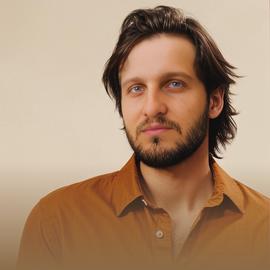
Stephon Alexander in American Physical Society

Theoretical physicist Stephon Alexander has a new paper out in Physical Review Letters entitled Cosmological Constant from Quantum Gravitational 𝜃 Vacua and the Gravitational Hall Effect.
Below is the abstract:
We provide a new perspective on the cosmological constant by exploring the background-independent Wheeler-DeWitt quantization of general relativity. The Chern-Simons-Kodama state of quantum gravity, a generalization of the Hartle-Hawking and Vilenkin states, has a striking structural similarity to the topological field theory of the quantum Hall effect. As a result, we study the gravitational topological 𝜃 sectors in analogy to Yang-Mills theory. We find that the cosmological constant Λ is intimately linked to the 𝜃 parameter by 𝜃=12𝜋2/(Λℓ2Pl) mod 2𝜋 due to the fact that Chern-Simons-Kodama state must live in a particular 𝜃 sector. This result is shown in the canonical, nonperturbative formalism. Furthermore, we explain how the physics of the Hamiltonian constraint is analogous to the quantum Hall effect, with the cosmological constant playing the role of a quantum gravitational Hall resistivity. These relations suggest that Λ is topologically protected against perturbative graviton loop corrections, analogous to the robustness of quantized Hall conductance against disorder in a metal.
The Quantum Hall Effect is about current in a magnetic field and quantized resistance in a conductor (i.e., small things). When paired with cosmology, it is a bit jarring. But Stephon, a STEMJazzer to the core and thus never one to ignore commonality across what seem disparate areas, thinks there’s a connection–one that might resolve a longstanding issue about the cosmological constant (and why everything in our universe holds together).
Kevin Stacey does his usual great job in describing the work for the non-physicists, but the basic idea is that there may be something about the topology of space-time that lends stability to the universe writ small and large.
Congratulations, Dr. Alexander!